
Low Voltage Cable Specification for Industrial Projects
Most LV cable problems are decided before the enquiry is sent. These are the six decisions that determine whether a 0.6/1kV cable performs for twenty years or fails in its first wet season.
Most LV cable problems are decided before the enquiry is sent. These are the six decisions that determine whether a 0.6/1kV cable performs for twenty years or fails in its first wet season.
Start from the circuit, not the catalogue
A cable schedule normally lists voltage, cores, cross-section and length. What it often omits is the installation method, the ambient temperature and the grouping — the three factors that decide whether the listed section is actually adequate.
Take the design current, apply the correction factors for ambient temperature, grouping and thermal insulation, then select the section from the relevant table. If the route is long, check voltage drop as a second pass; on 230 V circuits a 3 % drop is reached sooner than most people expect.
Confirm the conductor class
Class 1 solid conductors cost least and are fine for fixed wiring up to about 10 mm². Above that, Class 2 stranded is normal because solid large-section cable is difficult to bend and terminate.
Class 5 flexible conductors belong to moving applications and should not be used to save money on a fixed route; the fine strands are more susceptible to damage at terminations under vibration.
Choose insulation by temperature, not by habit
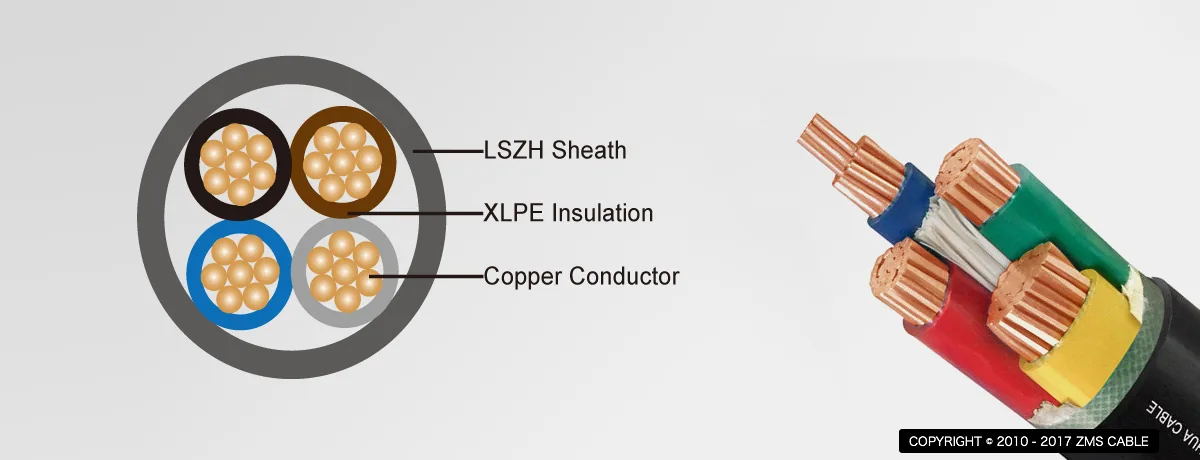
PVC is rated 70 °C and is adequate for dry, lightly loaded indoor circuits. XLPE is rated 90 °C, tolerates higher conductor temperatures and has better moisture resistance. The practical effect is that an XLPE cable of the same section carries more current, so a smaller conductor may satisfy the load.
If the cable runs through a plant room, near a furnace or on a roof exposed to sun, specify XLPE and confirm the derating for the actual ambient temperature.
Match the sheath to the environment
PVC ST2 is the default: abrasion resistant, flame retardant and adequate for trays, ducts and dry indoor routes. PE is specified for wet, buried or chemically active ground because it absorbs far less water.
LSZH sheathing is a fire-strategy decision rather than an electrical one. It belongs in tunnels, public buildings and confined spaces where smoke density and corrosive gas matter more than cost.
Protect the route
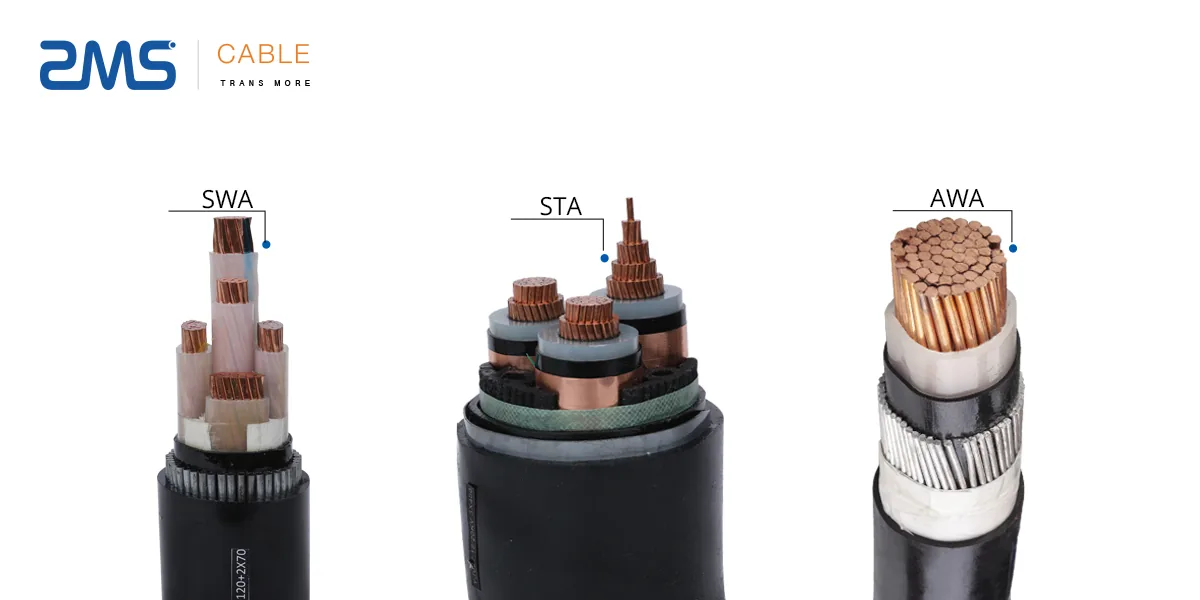
If the cable is buried without a duct, or crosses a yard where vehicles may work, armoured construction is the practical answer. Steel tape gives radial protection against impact and rodents; steel wire adds tensile strength for vertical runs.
Armour is not a substitute for route records. A digger will still find the cable, and the earthing design must account for the armour as a fault path.
Write the specification so it can be quoted
A specification that says “0.6/1kV XLPE cable, 4 core” will produce four different offers. State the standard (IEC 60502-1), conductor class, core identification, sheath compound, drum lengths, marking requirements and the documents you expect with delivery.
That level of detail also protects the buyer: it makes substitution visible and gives the inspector something to check against.
Request datasheet & price
Send the project specification and we will confirm construction, standard and delivery schedule. Samples for approval can be arranged.
Get a Quote WhatsApp UsRelated reading
LSZH vs PVC Cable: What Actually Changes in a Fire
What LSZH and PVC cable actually do in a fire: smoke density to IEC 61034, halogen gas to IEC 60754, flame propagation to IEC 60332 and the cost trade-off.
Armoured or Unarmoured: Choosing the Right LV Cable Route
How to choose between armoured and unarmoured low voltage cable by route: direct burial, ducts, trays, vertical risers, and what each construction costs.
Specifying cable for a project?
Send the schedule and the route description. We will confirm the construction and quote factory-direct.
Each of those six decisions lands on one of the LV constructions. Conductor class and current rating drive the PVC / XLPE insulated LV power cable; long runs at moderate load move to the aluminium conductor LV cable; the environment decides between a PE or LSZH sheath, and LSZH LV cable covers the indoor public spaces.